Quick Enquiry
 Notifications
 +91 8585858012
 Notice Board




How to Develop Leadership Skills in Students
Both hard skills and soft skills together lay the groundwork for a successful career. During school years, students acquire a range of hard and soft skills that they carry forward into their professional lives. These skills help shape their personality, work ethic, and ability to succeed in different fields. One of the most critical skills among them is leadership. It enables students to take responsibility, guide others, and make decisions confidently. In this article, we will discuss how to develop leadership skills in students.
Importance of leadership qualities in students
While hard skills build the foundation for a successful career, leadership skills play a crucial role in advancing it and fostering personal growth. Here are some reasons why developing leadership skills is so important.
1. Cultivates a sense of responsibility
Leadership helps cultivate a sense of accountability and responsibility. Leaders understand that they shoulder responsibilities that can affect the people around them. It empowers them and makes them more confident.
2. Encourages effective communication and networking
A leader must be a good communicator to achieve desired outcomes. Leadership helps students become good communicators. They learn to express ideas, collaborate with their peers, manage teams, and build strong relationships.
3. Enhances problem-solving
Leadership teaches students to step forward, take ownership, and solve problems. They learn to navigate everyday challenges, a skill that helps them throughout their lives.
4. Promotes critical thinking
Leaders analyze situations, reflect on different perspectives, and make informed decisions. It strengthens their critical thinking skills.
5. Prepares for future roles
When students take on leadership roles in schools, they develop a range of other essential soft skills. These abilities make them valuable assets and prepare them for future roles and responsibilities.
Qualities of a good leader
Leadership qualities in students pave the way for a prosperous future. But what are the traits that make someone a good leader? Let us find out:
- Effective communication skills
- Critical thinking skills
- Effective listening
- Self-discipline
- Conflict management
- Ability to motivate others
- Responsibility delegation
- Positive attitude
- Demonstrating initiative
- Decision making
- Driving results
- Improving team performance
- Emotional intelligence
How to develop leadership skills in students?
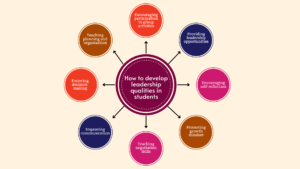
If you are a parent or teacher who wants to teach leadership skills to students, here are some effective strategies that might help:
1. Encouraging participation in group activities
Group activities are one of the best ways to teach students collaboration and leadership. Through these activities, they learn to take action, work as a team, motivate team members, manage conflicts, and delegate responsibilities.
Encourage students to participate in group activities, community service, or team sports. Extracurricular activities like these instill many essential soft skills that further fortify leadership qualities.
2. Providing leadership opportunities
Offer students positions in school or the community that inspire them to take responsibility and act. When students take on leadership roles, they develop essential skills that help them navigate the real world. By working in positions of responsibility, they cultivate the traits that make a good leader.
3. Encouraging self-reflection
Encourage students to reflect on their actions from time to time. Self-reflection makes them aware of their strengths and weaknesses and allows them to create actionable strategies for personal growth.
4. Promoting growth mindset
Having a positive mindset towards growth and learning guarantees success. It is one of the most essential leadership skills for students. Teachers and parents should always inspire students to learn and grow. As a teacher or parent, you should encourage children to face challenges with a positive attitude. Remind them that they can learn any skill.
5. Teaching negotiation skills
Learning the art of negotiation is essential for both personal and professional life. Teach students to think beyond “yes” and “no” and to consider every angle of an offer when making a decision. If an offer doesn’t meet their expectation, encourage them to negotiate respectfully.
6. Improving communication
The importance of good communication skills cannot be overstated. Develop classroom strategies that foster communication, such as facilitating discussions, teaching active listening, practicing public speaking, and enhancing writing skills. Strong communication not only boosts confidence but also helps instill leadership qualities.
7. Fostering decision-making
Leadership and decision-making go hand in hand. Leaders often face difficult situations that require quick decisions. Help your students develop decision-making skills by presenting them with problems or real-life scenarios that encourage critical thinking. Allow them to make choices in everyday situations to boost their confidence and sharpen their decision-making abilities. Additionally, teach them to understand and take responsibility for the consequences of their decisions.
8. Teaching planning and organization
Leaders are expected to create effective plans and strategies that inspire growth and success. Teach students the importance of planning and organizing by giving them opportunities to practice these skills. For example, assign them the responsibility of planning a small class event. Even simpler tasks like planning a daily routine can help them brainstorm and develop practical plans. Over time, these activities will strengthen their ability to plan effectively and stay organized.
The bottom line
Teaching leadership skills to students is essential for their overall growth and future success. It helps build confidence, teaches them to take responsibility, encourages collaboration, and strengthens decision-making abilities.
When students are encouraged to lead in small ways, by listening, taking initiative, and supporting their peers, they begin to see themselves as leaders. They learn many valuable lessons that go beyond the classroom.
Use these strategies to inspire leadership qualities in students, and prepare them not only for their careers but to become responsible, confident, and capable individuals.