Quick Enquiry
 Notifications
 +91 8585858012
 Notice Board



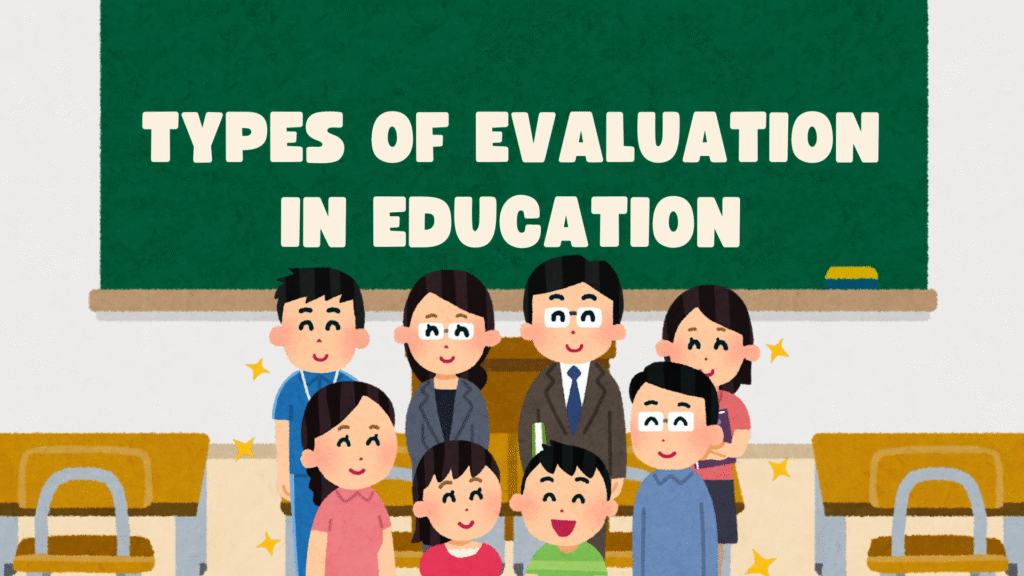
4 Types of Evaluation in Education for Tracking Students’ Growth
In our everyday lives, we take on different tasks and continue performing them with the expectation of getting better. But how do we know if we are improving? It is where having clear ways to measure our success becomes necessary, especially in the field of education. Different types of evaluation in education help educators to understand student learning, refine their methods, and guide the learning process. In this article, we will explore the concept of evaluation in education, its types, and various methods of evaluation in teaching.
What is evaluation?
Evaluation in education is the process of assessing student learning, performance, and progress against established learning objectives. It helps teachers monitor how well their students understand the material and adjust their teaching methods to meet diverse learning needs.
There are different types of evaluation in teaching that help teachers gain insight into student development, identify gaps, and enhance instructional methods. Since evaluation is a continuous process, it allows both teachers and students to make necessary changes that improve the overall quality of learning and teaching.
By using thoughtful evaluation methods, teachers can create more effective learning environments and support every student’s growth.
Types of evaluation in education
1. Formative Evaluation
Formative evaluation is an ongoing, continuous assessment that happens during the learning process. The primary purpose of this assessment is to monitor the student’s learning journey.
This feedback-focused evaluation process provides actionable feedback. Timely evaluation enables teachers to identify students’ strengths and weaknesses and adjust their instruction to support their learning better. Real-time guidance helps bridge learning gaps and yield desirable learning outcomes.
Formative evaluation is usually ungraded, or teachers give it minimal grades.
Some common methods of formative evaluation include:
- Classroom observation: As the name suggests, teachers observe their students’ performance in the classroom through their participation in lessons and group work.
- Assignments and projects: Teachers assess the students based on their skills, such as problem-solving and creative thinking.
- Quizzes, tests, and class discussions: Timely tests and quizzes to assess students’ understanding of lessons.
- Peer assessment: Collaborative learning accomplished by letting students assess each other’s work.
- Self-assessment: Students assess their work to identify their strengths and weaknesses.
2. Summative evaluation
Summative evaluation takes place at the end of the term, course, or academic year. It provides the complete account of students’ learning. It determines students’ eligibility to progress to another grade. An exam takes place after the completion of the syllabus, and teachers evaluate students’ performance. Students receive certificates on completion of the evaluation.
Apart from determining the effectiveness of instructions, summative assessment determines whether a student graduates.
Some common methods of summative assessment include
- Final exams: A summative assessment to determine whether students have met their learning goals.
- Projects: Projects or assignments, such as presentations, to assess project-based learning.
- Performance tasks: Practical exams and viva voce to assess students’ understanding of the practical application of their learning.
- Portfolio reviews: Evaluating students’ work (collected over a period of time) to determine their overall learning and growth.
3. Diagnostic evaluation
As the name suggests, diagnostic evaluation happens even before a teacher delivers instructions. It helps identify students’ existing knowledge, current skill set, strengths, and weaknesses to improve their performance. It also entails identifying any hindrances to learning and implementing necessary instructional changes to enhance students’ performance on summative assessments.
Some common methods of diagnostic evaluation include-
- Teacher interviews: Interviews to determine prior knowledge, learning experiences, and interpersonal difficulties.
- Pre-tests: Tests to determine a student’s starting level in relation to the class average.
- Reading assessments: Tests to determine fluency and comprehension.
- Diagnostic quizzes: Quizzes to assess knowledge and understanding of foundational concepts.
- Learning style surveys: Surveys to determine different learning methods.
4. Placement evaluation
This type of evaluation is conducted at the beginning of the year to determine a student’s suitable level. This assessment helps identify students’ abilities, strengths, and weaknesses and determine the right course or grade based on the findings.
This assessment ensures that a student is at an apt learning level; not under- or over-placed.
Some common methods of placement evaluation include-
- Admission tests: Determine the general aptitude and knowledge of a particular level required for a specific class.
- Language proficiency tests: Determine language fluency and the appropriate language group for students.
- Subject-specific placement tests: Determine a student’s proficiency in a specific subject. It also helps to identify difficulties in subjects like math and science.
- Teacher recommendation: Determine students’ comprehension based on classroom interactions.
- Academic records: Analyze students’ records and performance to determine appropriate placement.
Types of referencing in evaluation
Evaluation is a process of assessing performance, learning, or outcomes. To make educational evaluation more meaningful, educators use a reference point.
Here are the different types of referenced evaluation methods:
1. Self-referenced
In this type of evaluation in education, teachers assess students’ growth by comparing their previous performance with their current performance.
2. Criterion-referenced
In this method, a criterion is set to assess students’ performance. For instance, teachers can set objectives or goals that each student must meet after completing a topic or chapter within a set time limit.
It provides teachers with a reference point for analyzing students’ performance.
3. Norm-referenced
Norm-referenced evaluation is a method of evaluating students by comparing their performance with that of their peers. This approach helps to identify relative strengths and weaknesses.
By understanding where each student stands relative to others, teachers can identify who may need extra support and who can do better on their own. It helps them adjust their teaching strategies and create tailored learning plans for students.
Conclusion
Using the types of evaluation in education at best makes a powerful catalyst for success. It is more than checking progress. It encourages students and teachers to reflect on their efforts and understand their learning experiences. A well-planned evaluation system fosters clarity by showing learners the direction of their progress and the steps they should take to improve. It motivates them to engage more actively with their learning and recognize their strengths and weaknesses.
It helps teachers curate a learning environment where curiosity and effort are equally important as results. Consistent evaluation supports continuous development and empowers both teachers and students.