Quick Enquiry
 Notifications
 +91 8585858012
 Notice Board



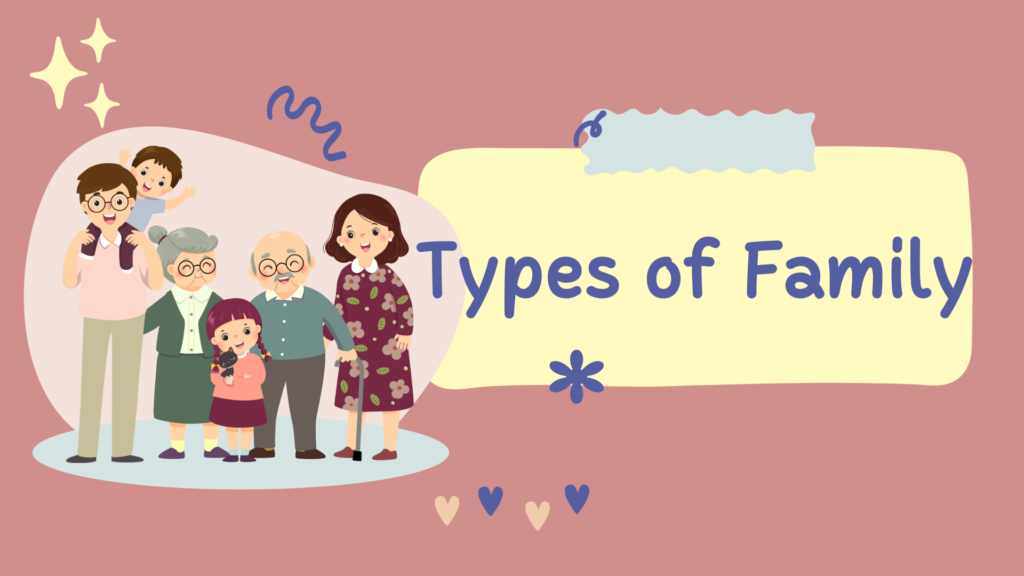
17 Types of Family in Sociology and How They Shape Our Society
A family is a fundamental social institution that most children are born into. The structure constitutes of parents responsible of birthing a child to provide emotional, social, and economic support to individuals till they are adults. It is a system that ideally ensures growing children develop values, love, and sense of belonging. There are different types of families that vary across cultures and communities. The variation is based on size, composition, marriage, authority, and living arrangement. In this article, we will introduce you to the different types of family in sociology.
How many types of family are there in sociology?
Families vary in size, structure, authority, residence, descent, and marriage patterns. Here are the different types of family in sociology:
On the basis of size and structure
The types of family based on size and structure are:
1. Nuclear family
It is a small, autonomous family that includes father and mother (married or unmarried) and their biological or adopted children living as a single household. This family does not include extended relatives like grandparents, uncles, aunts, or cousins.
2. Joint family
It is a family system in which two or more generations live together in a shared household. They share income, responsibilities, resources, and property. A joint family includes grandparents, parents, unmarried children, and married children with their spouses and children.
3. Extended family
It is a family system that includes other relatives connected by marriage or blood. These relatives commonly include grandparents, uncles, aunts, cousins, and sometimes, in-laws. This type of family may share a household or maintain close ties while living separately. The members remain emotionally, economically, and socially connected.
4. Childless family
As the name denotes, a childless family consists of a married couple without children. The absence of children may be a personal choice or due to issues like infertility. Common in modern society, these families are smaller in size but maintain strong marital bonds. The couple shares emotional, social, and economic responsibilities.
5. Single-parent family
In this family structure, one parent, either the father or the mother, lives with and shoulders the responsibility of one or more children. The parent is responsible for economic support, caregiving, and decision-making.
6. Reconstituted family
Also called a stepfamily or blended family, a reconstituted family is one in which either one or both parents have children from previous relationships. These families can be of two types:
Simple reconstituted family
In this family, either husband or wife has a child that is not biologically related to their spouse.
Complex reconstituted family
In this family, both parents have children from their previous relationships.
On the basis of residence
There are four types of family based on residence. They are:
7. Patrilocal family
In this type of family, the wife moves to her husband’s residence after marriage. It is commonly found in patrilineal societies.
8. Matrilocal family
In this type of family, the husband moves into his wife’s residence after marriage. It is commonly associated with matrilineal societies.
9. Bilocal family
In this type of family, the married couple may live with either the husband’s or the wife’s family. If both the families live together, then too they form a bilocal family.
10. Neolocal family
In this type of family, the newlyweds establish an independent residence separate from both families.
On the basis of authority
There are 3 types of family based on authority. They include:
11. Patriarchal family
A family governed by a father is called a patriarchal family. In this family, the father or the eldest male member holds power and authority. They exercise control over family affairs and make decisions for every member.
Generation after generation authority is transferred to a male heir who is often the eldest son. Patriarchal families are commonly associated with patrilocal residence and patrilineal descent.
Majority of Indian households are primarily patriarchal. According to study done towards India Patriarchy Index (IPI) in 2021, north Indian states of Haryana, Rajasthan, Uttar Pradesh, Punjab alongside Madhya Pradesh, Bihar, Jharkhand and Gujarat are more patriarchal in nature compared to southern and north eastern states.
12. Matriarchal family
A family in which women hold the dominant position in life are matriarchal in nature. They are often associated with matrilineal descent and matrilocal residence, though authority may not always rest entirely with women.
The Khasi, Garo, and Jaintia tribes of Meghalaya are matriarchal. Interestingly, properties are owned by women and transferred to daughters instead of sons. After marriage, men move to their in-laws house and abide by the norms of matrilineal traditions.
13. Egalitarian family
An egalitarian family is one in which both partners share authority, decision-making, and responsibilities more or less equally. In these families, power is not concentrated in one gender.
On the basis of descent
On the basis of descent, families can be:
14. Patrilineal family
A family system in which descent, lineage, and inheritance are traced through the father’s line. Family name is passed through the male line, and property and inheritance usually pass from father to son. Furthermore, children belong to the father’s kin group. This type of family is often associated with patrilocal residence and patriarchal authority.
15. Matrilineal family
A family system in which ancestry is traced through the mother. Family name and lineage are passed through the female line, and property and inheritance usually pass from a woman to her children or relatives on the mother’s side. Children belong to the mother’s kin group.
On the basis of marriage
These are the types of family, based on marriage:
16. Polygamous family:
It is the type of family in which one individual is married to more than one spouse simultaneously. There are two types of polygamous families:
Polygynous family
In this family, one man is married to two or more women. Many Islamic countries permit men to have multiple marriages as per their religious beliefs.
Polyandrous family
In this family, one woman is married to two or more men. Parts of Nepal, Tibet and Bhutan allow such familial dynamics.
17. Monogamous family
When a man and a woman have each other as their spouses and no other relationship or marriages apart from that, their family is a monogamous one.
Cultural differences caused by familial dynamics
These different types of families reflect differences in traditions, beliefs, and social practices. Families may vary in composition, authority, and living arrangement, but their basic role is to provide stability and protection.
Families are not static. They evolve in response to changing social, economic, and cultural conditions. Understanding the types of family helps us understand social relationships and the functioning of society. Moreover, it offers a glimpse into the adaptability of human social organization to meet the needs of individuals and communities.